EntryPoint
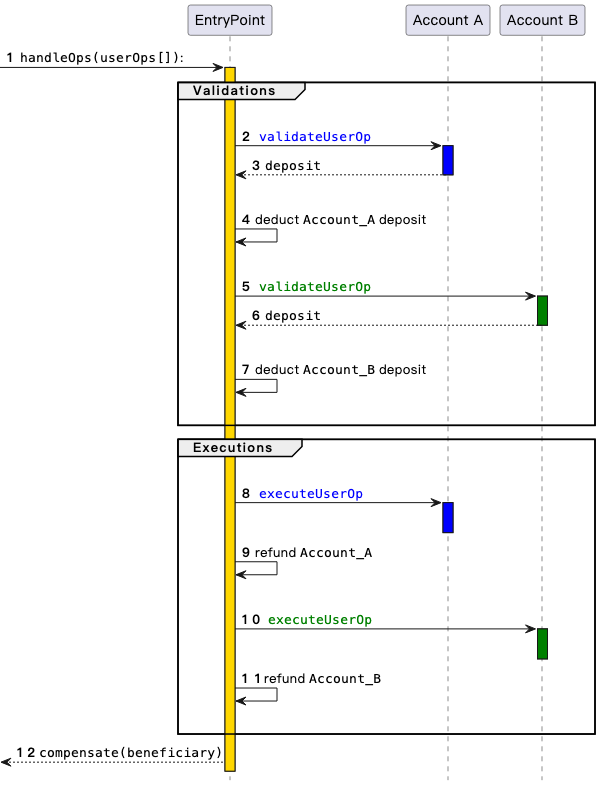
This page documents the on-chain interface of the EntryPoint deployed on BOT Chain. When submitting UserOperations directly, the caller must assume the responsibilities of a Bundler.
1. PackedUserOperation
EntryPoint accepts the following on-chain structure:
struct PackedUserOperation {
    address sender;
    uint256 nonce;
    bytes initCode;
    bytes callData;
    bytes32 accountGasLimits;
    uint256 preVerificationGas;
    bytes32 gasFees;
    bytes paymasterAndData;
    bytes signature;
}
1.1 Fields and encoding
| Field | Meaning | Encoding layout |
|---|---|---|
sender | Smart-account address | smartAccount(160) |
nonce | Two-dimensional nonce managed by EntryPoint | key(192) ‖ sequence(64) |
initCode | Factory address and calldata used for first deployment | Undeployed: factory(160) ‖ factoryData(N); deployed: 0x |
callData | Execution data sent to the smart account | selector(32) ‖ encodedArguments(N) |
accountGasLimits | Gas limits for account validation and execution | verificationGasLimit(128) ‖ callGasLimit(128) |
preVerificationGas | Calldata and bundle overhead outside on-chain validation | preVerificationGas(256) |
gasFees | EIP-1559 priority fee and maximum total fee | maxPriorityFeePerGas(128) ‖ maxFeePerGas(128) |
paymasterAndData | Optional Paymaster address, Gas limits, and custom data | Used: paymaster(160) ‖ paymasterVerificationGasLimit(128) ‖ paymasterPostOpGasLimit(128) ‖ paymasterData(N); unused: 0x |
signature | Authorization data validated by the smart account | accountSignature(N) |
Numbers in parentheses are bit lengths; N denotes a variable length.
2. Execution interfaces
function handleOps(
    PackedUserOperation[] calldata ops,
    address payable beneficiary
) external;

function handleAggregatedOps(
    UserOpsPerAggregator[] calldata opsPerAggregator,
    address payable beneficiary
) external;
2.1 handleOps
| Parameter | Description |
|---|---|
ops | UserOperations that do not use a signature aggregator |
beneficiary | Address that receives the actual Gas fees for the batch |
EntryPoint validates the entire batch before executing each account's callData. A validation error can revert the entire batch. A business-execution revert is recorded through an event and does not necessarily revert the outer transaction.
2.2 handleAggregatedOps
Use this method when accounts return a non-zero signature aggregator. UserOperations are grouped by aggregator, and each group carries an aggregated signature. Use handleOps when signature aggregation is not required.
UserOpsPerAggregator contains:
| Field | Type | Description |
|---|---|---|
userOps | PackedUserOperation[] | Operations handled by the current aggregator |
aggregator | IAggregator | Aggregator for the group; only in handleAggregatedOps, a zero-address group means that no aggregation is needed |
signature | bytes | Aggregated signature for the group |
3. Hash, nonce, and address
function getUserOpHash(
    PackedUserOperation calldata userOp
) external view returns (bytes32);

function getNonce(
    address sender,
    uint192 key
) external view returns (uint256 nonce);

function incrementNonce(uint192 key) external;

function getSenderAddress(bytes memory initCode) external;
3.1 getUserOpHash
Returns the UserOperation hash that the account must validate. The hash binds:
- UserOperation content, excluding
signature - Current EntryPoint address
- Current chainId
Changing any participating field after signing invalidates the signature.
3.2 getNonce
Returns the next complete nonce for an account and nonce key:
nonce = uint192 key || uint64 sequence
SimpleAccount uses key 0 by default. Do not substitute the Owner EOA transaction nonce or the smart account's eth_getTransactionCount.
3.3 incrementNonce
Allows a caller to advance the sequence for one of its nonce keys. Standard accounts usually rely on EntryPoint to update the nonce after successful validation.
3.4 getSenderAddress
Calculates a counterfactual account address from initCode. The method always reverts and returns the result through the custom error SenderAddressResult(address sender).
4. Deposit and stake
function getDepositInfo(
    address account
) external view returns (DepositInfo memory info);

function balanceOf(address account)
    external view returns (uint256);

function depositTo(address account) external payable;

function withdrawTo(
    address payable withdrawAddress,
    uint256 withdrawAmount
) external;

function addStake(uint32 unstakeDelaySec) external payable;

function unlockStake() external;

function withdrawStake(
    address payable withdrawAddress
) external;
4.1 Deposit
A deposit is the balance that an account or Paymaster pre-funds in EntryPoint to pay UserOperation Gas.
| Method | Description |
|---|---|
balanceOf | Queries an entity's deposit |
getDepositInfo | Queries deposit, stake, and unlock state together |
depositTo | Allows any address to fund the specified entity |
withdrawTo | Withdraws the caller's own deposit |
4.2 Stake
A stake is locked by a Factory, Paymaster, or aggregator to satisfy validation and reputation rules. It is not used directly to pay UserOperation Gas.
| Method | Description |
|---|---|
addStake | Adds stake and sets a minimum unlock delay |
unlockStake | Begins the unlock waiting period |
withdrawStake | Withdraws the stake after the waiting period |
Deposit and stake are independent. A stake alone cannot pay Gas, and a deposit alone does not necessarily satisfy the Bundler's stake requirement for entities that access restricted storage.
5. Core events
| Event | Key fields | Purpose |
|---|---|---|
UserOperationEvent | userOpHash, sender, paymaster, nonce, success, actualGasCost, actualGasUsed | Determines the final result of each UserOperation |
AccountDeployed | userOpHash, sender, factory, paymaster | Records counterfactual account deployment |
UserOperationRevertReason | userOpHash, sender, nonce, revertReason | Records revert data from the account's business call |
PostOpRevertReason | userOpHash, sender, nonce, revertReason | Records a Paymaster postOp revert |
UserOperationPrefundTooLow | userOpHash, sender, nonce | Records insufficient prefund during execution |
BeforeExecution | None | Separates validation-stage and execution-stage events |
Deposited / Withdrawn | account, amount | Records deposit changes |
StakeLocked / StakeUnlocked / StakeWithdrawn | account, stake, time | Records the stake lifecycle |
A successful outer handleOps transaction does not mean that every UserOperation succeeded. Use UserOperationEvent.success as the result.
6. Core errors
| Error | Description |
|---|---|
FailedOp(opIndex, reason) | The specified UserOperation failed during validation or prefunding |
FailedOpWithRevert(opIndex, reason, inner) | Failure with internal revert data from an account, Factory, or Paymaster |
PostOpReverted(returnData) | Paymaster postOp reverted |
SignatureValidationFailed(aggregator) | Aggregated signature validation failed |
SenderAddressResult(sender) | Expected result carrier for getSenderAddress |