Bundler RPC
The BOT Chain Bundler accepts RPC UserOperations, runs simulations, maintains the UserOperation queue, and uses a Relayer to call EntryPoint through a standard transaction. The standard BOT Chain RPC does not provide eth_sendUserOperation.
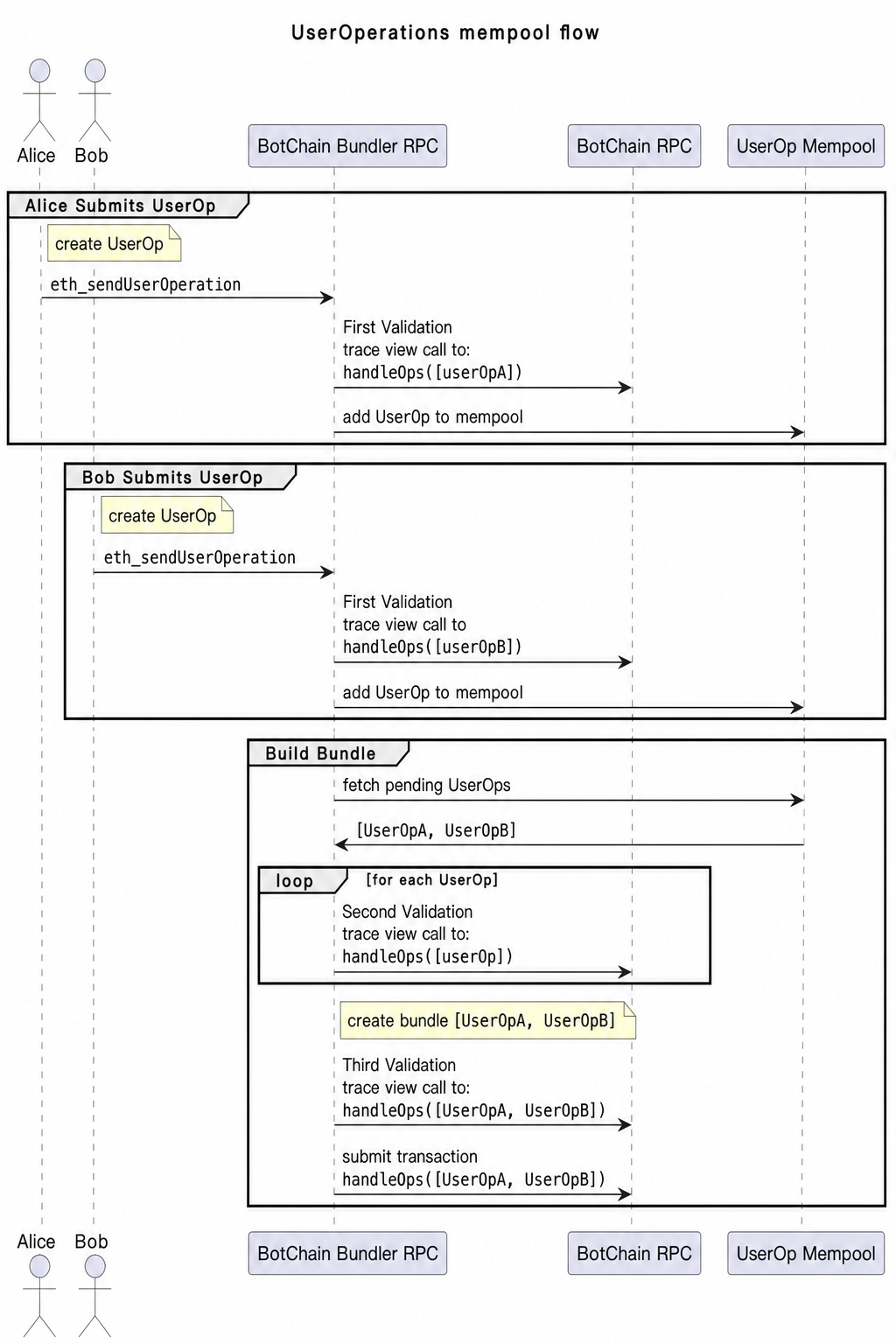
1. RPC UserOperation v0.7
BOT Chain uses EntryPoint v0.7 and is not compatible with the v0.6 field format.
1.1 Bundler RPC request structure
{
  "sender": "0x...",
  "nonce": "0x...",
  "factory": "0x...",
  "factoryData": "0x...",
  "callData": "0x...",
  "callGasLimit": "0x...",
  "verificationGasLimit": "0x...",
  "preVerificationGas": "0x...",
  "maxFeePerGas": "0x...",
  "maxPriorityFeePerGas": "0x...",
  "paymaster": "0x...",
  "paymasterVerificationGasLimit": "0x...",
  "paymasterPostOpGasLimit": "0x...",
  "paymasterData": "0x...",
  "signature": "0x..."
}
1.2 Fields
| Field | Type | Gas estimation | Final submission | Description |
|---|---|---|---|---|
sender | address (20-byte, 0x-prefixed hexadecimal address) | Required | Required | Smart-account address, including a counterfactual address that has not been deployed |
nonce | QUANTITY (0x-prefixed hexadecimal integer without redundant leading zeros; zero is 0x0) | Required | Required | Account nonce managed by EntryPoint |
factory | address | Conditional | Conditional | Factory used for the account's first deployment |
factoryData | DATA (even-length, 0x-prefixed hexadecimal bytes; empty is 0x) | Conditional | Conditional | Calldata for the Factory to create the account |
callData | DATA | Required | Required | Business execution data sent to the smart account |
callGasLimit | QUANTITY | May be omitted or temporary | Required | Gas limit for account execution |
verificationGasLimit | QUANTITY | May be omitted or temporary | Required | Gas limit for Factory and account validation |
preVerificationGas | QUANTITY | May be omitted or temporary | Required | Fixed calldata and bundle overhead |
maxFeePerGas | QUANTITY | Optional | Required | Maximum total Gas price |
maxPriorityFeePerGas | QUANTITY | Optional | Required | Maximum priority fee |
paymaster | address | Conditional | Conditional | Paymaster that pays the Gas |
paymasterVerificationGasLimit | QUANTITY | Conditional | Conditional | Gas limit for Paymaster validation |
paymasterPostOpGasLimit | QUANTITY | Conditional | Conditional | Gas limit for Paymaster postOp |
paymasterData | DATA | Optional | Optional | Custom Paymaster authorization or policy data |
signature | DATA | Required; a placeholder may be used | Required; real authorization | Interpreted and validated by the sender account |
2. Construct a UserOperation
The following TypeScript snippets can be combined and run in order. The example uses BOT Chain Testnet, SimpleAccount, and no Paymaster. Install viem first:
npm install viem
Shared configuration and the RPC helper:
import {
  createPublicClient,
  encodeFunctionData,
  http,
  parseAbi,
  toHex,
  type Hex,
} from "viem";
import { getUserOperationHash } from "viem/account-abstraction";
import { privateKeyToAccount } from "viem/accounts";

const CHAIN_ID = 968;
const RPC_URL = "https://rpc.bohr.life";
const BUNDLER_URL = "https://bundler.bohr.life/rpc/";
const ENTRY_POINT = "0x0000000071727De22E5E9d8BAf0edAc6f37da032";
const FACTORY = "0xBC88d6012b3bf8426C2851d3798cEB5257658332";

const ownerPrivateKey = process.env.OWNER_PRIVATE_KEY;
if (!ownerPrivateKey) throw new Error("OWNER_PRIVATE_KEY is required");

const owner = privateKeyToAccount(ownerPrivateKey as Hex);
const publicClient = createPublicClient({ transport: http(RPC_URL) });

const factoryAbi = parseAbi([
  "function getAddress(address owner, uint256 salt) view returns (address)",
  "function createAccount(address owner, uint256 salt) returns (address)",
]);
const entryPointAbi = parseAbi([
  "function getNonce(address sender, uint192 key) view returns (uint256)",
  "function balanceOf(address account) view returns (uint256)",
]);
const simpleAccountAbi = parseAbi([
  "function execute(address dest, uint256 value, bytes func)",
]);

async function bundlerRpc<T>(
  method: string,
  params: unknown[] = [],
): Promise<T> {
  const response = await fetch(BUNDLER_URL, {
    method: "POST",
    headers: {
      "Content-Type": "application/json",
    },
    body: JSON.stringify({
      jsonrpc: "2.0",
      id: 1,
      method,
      params,
    }),
  });

  const payload = (await response.json()) as {
    result?: T;
    error?: {
      code: number;
      message: string;
      data?: unknown;
    };
  };

  if (!response.ok || payload.error) {
    const errorMessage = payload.error
      ? `${payload.error.code}: ${payload.error.message}`
      : `HTTP ${response.status}`;

    throw new Error(errorMessage);
  }

  if (payload.result === undefined) {
    throw new Error(`Bundler returned no result for ${method}`);
  }

  return payload.result;
}
The example reads the Owner private key from an environment variable and is only suitable for server-side or local testing. Browser applications should use an account supplied by a wallet and must never embed private keys in frontend code.
2.1 Determine sender
sender is the smart-account address, not the Owner EOA.
- SimpleAccount derives it through
SimpleAccountFactory.getAddress(owner, salt). - A custom account follows its own Factory or deployment rules.
- Use the chain RPC method
eth_getCodeto determine whethersenderhas already been deployed.
const salt = 0n;

const sender = await publicClient.readContract({
  address: FACTORY,
  abi: factoryAbi,
  functionName: "getAddress",
  args: [owner.address, salt],
});

const accountCode = await publicClient.getCode({ address: sender });
const accountDeployed = accountCode !== undefined && accountCode !== "0x";
2.2 Set the Factory fields
| Account state | factory | factoryData |
|---|---|---|
| Not deployed | Provide the Factory address | Provide ABI-encoded account-creation calldata |
| Already deployed | Omit | Omit |
For BOT Chain SimpleAccount, factoryData encodes createAccount(owner, salt). Supplying Factory fields for an already deployed account triggers AA10 sender already constructed.
const factoryFields = accountDeployed
  ? {}
  : {
      factory: FACTORY,
      factoryData: encodeFunctionData({
        abi: factoryAbi,
        functionName: "createAccount",
        args: [owner.address, salt],
      }),
    };
2.3 Read the nonce
Read the nonce from EntryPoint through getNonce(sender, key):
High 192 bits: nonce key
Low 64 bits: sequence for that key
BOT Chain SimpleAccount uses key 0 by default. Do not substitute the Owner EOA transaction nonce, the smart account's eth_getTransactionCount, or a local counter that is not synchronized with EntryPoint.
const nonce = await publicClient.readContract({
  address: ENTRY_POINT,
  abi: entryPointAbi,
  functionName: "getNonce",
  args: [sender, 0n],
});
2.4 Generate callData
The smart-account implementation defines callData:
- BOT Chain SimpleAccount uses
executeorexecuteBatch. - A custom account uses its own public execution interface.
callDatamust comply with the authorization policy enforced by the account invalidateUserOp.
// This example uses a call with no value and empty calldata to demonstrate encoding.
// Replace these values with the business contract, transfer value, and calldata.
const target = owner.address;
const targetValue = 0n;
const targetCallData = "0x";

const callData = encodeFunctionData({
  abi: simpleAccountAbi,
  functionName: "execute",
  args: [target, targetValue, targetCallData],
});
2.5 Choose the Gas payer
| Scenario | Fields and funding requirements |
|---|---|
| No Paymaster | Omit all Paymaster fields and ensure the account deposit is sufficient |
| With a Paymaster | Provide the Paymaster address, both Paymaster Gas limits, and the implementation-specific data |
Do not provide the zero address when a Paymaster is not used. BOT Chain does not provide a public Paymaster, but developers can deploy their own.
This example does not use a Paymaster. Before estimation, it checks the EntryPoint deposit and the account's native-token balance:
const [entryPointDeposit, senderBalance] = await Promise.all([
  publicClient.readContract({
    address: ENTRY_POINT,
    abi: entryPointAbi,
    functionName: "balanceOf",
    args: [sender],
  }),
  publicClient.getBalance({ address: sender }),
]);

if (entryPointDeposit === 0n && senderBalance === 0n) {
  throw new Error(
    "Fund the sender or deposit funds for it in EntryPoint before estimating",
  );
}
2.6 Construct the UserOperation for estimation
This object is the userOp argument of eth_estimateUserOperationGas(userOp, entryPoint). It is used only for Bundler simulation and Gas estimation; it does not send a transaction.
| Field group | Estimation stage |
|---|---|
| sender, nonce, callData | Use final values |
| factory, factoryData | Provide or omit according to deployment state |
| Paymaster fields | Provide or omit according to the sponsorship mode |
| Three Gas limits | May be omitted, zero, or temporary |
| Gas prices | Optional; the Bundler returns suggested values |
| signature | Use a placeholder with a format and length suitable for account validation |
The current Skandha implementation accepts empty DATA (0x) and substitutes an internal placeholder during estimation. When an explicit placeholder with the same length as the final signature is required, BOT Chain SimpleAccount can use this 65-byte placeholder:
0xfffffffffffffffffffffffffffffff0000000000000000000000000000000007aaaaaaaaaaaaaaaaaaaaaaaaaaaaaaaaaaaaaaaaaaaaaaaaaaaaaaaaaaaaaaa1c
The placeholder is only for Gas estimation and cannot be used in the final submission.
const DUMMY_SIGNATURE =
  "0xfffffffffffffffffffffffffffffff0000000000000000000000000000000007aaaaaaaaaaaaaaaaaaaaaaaaaaaaaaaaaaaaaaaaaaaaaaaaaaaaaaaaaaaaaaa1c";

const gasPrice = await bundlerRpc<{
  maxFeePerGas: Hex;
  maxPriorityFeePerGas: Hex;
}>("skandha_getGasPrice");

const estimateUserOperation = {
  sender,
  nonce: toHex(nonce),
  ...factoryFields,
  callData,
  callGasLimit: "0x0",
  verificationGasLimit: "0x0",
  preVerificationGas: "0x0",
  maxFeePerGas: gasPrice.maxFeePerGas,
  maxPriorityFeePerGas: gasPrice.maxPriorityFeePerGas,
  signature: DUMMY_SIGNATURE,
};
2.7 Apply the Gas estimate
After eth_estimateUserOperationGas returns, copy these values into the final UserOperation:
callGasLimitverificationGasLimitpreVerificationGasmaxFeePerGasmaxPriorityFeePerGas- Both Paymaster Gas limits when using a Paymaster
After applying the estimate, all final fields except signature should remain unchanged.
type UserOperationGasEstimate = {
  callGasLimit: Hex;
  verificationGasLimit?: Hex;
  verificationGas?: Hex;
  preVerificationGas: Hex;
  maxFeePerGas?: Hex;
  maxPriorityFeePerGas?: Hex;
};

const gasEstimate = await bundlerRpc<UserOperationGasEstimate>(
  "eth_estimateUserOperationGas",
  [estimateUserOperation, ENTRY_POINT],
);

const verificationGasLimit =
  gasEstimate.verificationGasLimit ?? gasEstimate.verificationGas;
if (!verificationGasLimit) {
  throw new Error("Bundler did not return verificationGasLimit");
}

const finalUserOperation = {
  ...estimateUserOperation,
  callGasLimit: gasEstimate.callGasLimit,
  verificationGasLimit,
  preVerificationGas: gasEstimate.preVerificationGas,
  maxFeePerGas: gasEstimate.maxFeePerGas ?? gasPrice.maxFeePerGas,
  maxPriorityFeePerGas:
    gasEstimate.maxPriorityFeePerGas ?? gasPrice.maxPriorityFeePerGas,
};
2.8 Calculate userOpHash
The function accepts the unpacked Bundler RPC form of a UserOperation, but QUANTITY fields must first be converted to bigint:
const sdkUserOperation = {
  ...finalUserOperation,
  nonce: BigInt(finalUserOperation.nonce),
  callGasLimit: BigInt(finalUserOperation.callGasLimit),
  verificationGasLimit: BigInt(finalUserOperation.verificationGasLimit),
  preVerificationGas: BigInt(finalUserOperation.preVerificationGas),
  maxFeePerGas: BigInt(finalUserOperation.maxFeePerGas),
  maxPriorityFeePerGas: BigInt(finalUserOperation.maxPriorityFeePerGas),
};

const userOpHash = getUserOperationHash({
  userOperation: sdkUserOperation,
  entryPointAddress: ENTRY_POINT,
  entryPointVersion: "0.7",
  chainId: CHAIN_ID,
});
This function performs a pure off-chain calculation. entryPointAddress, entryPointVersion, and chainId all contribute to the final hash and must match the target network. signature does not contribute to the hash, so the placeholder can remain at this stage.
2.9 Obtain the final signature
Use an account wallet, SDK, or signing service to sign userOpHash and produce the final signature.
- BOT Chain SimpleAccount requires the Owner to sign the UserOperation hash with EIP-191 ECDSA.
- A custom account may use multisig, Session Keys, aggregated signatures, or another validation scheme.
The real signature must match the implementation of sender.validateUserOp. Do not change any hash-participating field after signing.
const signature = await owner.signMessage({
  message: { raw: userOpHash },
});

const signedUserOperation = {
  ...finalUserOperation,
  signature,
};
2.10 Submit and query the result
Submit the final RPC UserOperation through eth_sendUserOperation. The Bundler returns a userOpHash. The application then polls the query methods to track the bundle transaction and execution receipt.
const submittedUserOpHash = await bundlerRpc<Hex>(
  "eth_sendUserOperation",
  [signedUserOperation, ENTRY_POINT],
);

if (submittedUserOpHash.toLowerCase() !== userOpHash.toLowerCase()) {
  throw new Error("Bundler returned an unexpected userOpHash");
}

type UserOperationReceipt = {
  success: boolean;
  receipt: { transactionHash: Hex };
};

let userOperationReceipt: UserOperationReceipt | null = null;
for (let attempt = 0; attempt < 60 && !userOperationReceipt; attempt++) {
  userOperationReceipt = await bundlerRpc<UserOperationReceipt | null>(
    "eth_getUserOperationReceipt",
    [submittedUserOpHash],
  );
  if (!userOperationReceipt) {
    await new Promise((resolve) => setTimeout(resolve, 2_000));
  }
}

if (!userOperationReceipt) {
  throw new Error("Timed out waiting for UserOperation receipt");
}

console.log({
  userOpHash: submittedUserOpHash,
  transactionHash: userOperationReceipt.receipt.transactionHash,
  success: userOperationReceipt.success,
});
3. Bundler RPC methods
3.1 eth_supportedEntryPoints
Returns the EntryPoint addresses accepted by the Bundler. The result should include the configured EntryPoint deployment. Applications should also verify that the Bundler's eth_chainId matches the chain RPC.
3.2 eth_estimateUserOperationGas
3.2.1 Parameters
| Position | Parameter | Type | Description |
|---|---|---|---|
| 1 | userOp | Estimate UserOperation | RPC UserOperation to simulate |
| 2 | entryPoint | address | EntryPoint supported by the Bundler |
| 3 | stateOverrides | object, optional | Account-state overrides used only for simulation |
State overrides are keyed by address and support balance, nonce, code, state, and stateDiff. They affect only the current simulation.
3.2.2 Result
| Field | Type | Description |
|---|---|---|
callGasLimit | QUANTITY | Gas limit for account execution |
verificationGasLimit | QUANTITY | Gas limit for Factory and account validation |
verificationGas | QUANTITY | Validation Gas alias returned by Skandha |
preVerificationGas | QUANTITY | Fixed calldata and bundle overhead |
maxFeePerGas | QUANTITY | Suggested maximum total Gas price |
maxPriorityFeePerGas | QUANTITY | Suggested maximum priority fee |
paymasterVerificationGasLimit | QUANTITY, optional | Gas limit for Paymaster validation |
paymasterPostOpGasLimit | QUANTITY, optional | Gas limit for Paymaster postOp |
validAfter | QUANTITY, optional | Start of the validation time range |
validUntil | QUANTITY, optional | End of the validation time range |
3.3 eth_sendUserOperation
The parameters are the final RPC UserOperation and the EntryPoint address. The method returns a bytes32 userOpHash, not the outer handleOps transaction hash.
Bundler acceptance only means that the UserOperation entered the packaging flow; it does not mean that the operation has been included on-chain or executed successfully.
3.4 eth_getUserOperationByHash
Returns null when no operation is found. Otherwise it returns:
| Field | Description |
|---|---|
userOperation | Original RPC UserOperation |
entryPoint | Execution entry point |
blockNumber | Included block number, optional |
blockHash | Included block hash, optional |
transactionHash | Outer handleOps transaction hash, optional |
A UserOperation that is still in the mempool may not have transaction or block fields.
3.5 eth_getUserOperationReceipt
Returns null until the operation is included on-chain. The primary fields after inclusion are:
| Field | Description |
|---|---|
userOpHash | UserOperation hash |
sender | Smart account |
nonce | UserOperation nonce |
paymaster | Gas-paying Paymaster, optional |
actualGasCost | Actual Gas cost |
actualGasUsed | Actual Gas used |
success | Whether account business execution succeeded |
reason | Failure reason, optional |
logs | Logs related to the UserOperation |
receipt | Outer handleOps transaction receipt |
Use success as the final business result. A successful outer transaction does not mean that every UserOperation inside it succeeded.
3.6 skandha_getGasPrice
This extension method takes no parameters and returns maxFeePerGas and maxPriorityFeePerGas. To support other Bundlers, a fallback strategy must still produce both fields. The chain RPC's eth_gasPrice may be used as a pricing input, but it is not a complete EIP-1559 two-field quote. Do not set the UserOperation Gas price to zero even if the on-chain base fee is zero.
4. Troubleshooting
| Symptom | What to check |
|---|---|
Invalid Entrypoint | Bundler-supported list, network, and EntryPoint address |
| Parameter validation fails | QUANTITY and DATA encoding, address length, and conditional fields |
AA10 | An already deployed account still includes Factory fields |
AA21 | Account deposit or prefund is insufficient |
AA24 | Account signature, hash, chainId, or EntryPoint does not match |
AA25 | Nonce was already used or violates the account policy |
AA31 / AA33 | Paymaster deposit is insufficient or validation failed |
| Receipt does not appear | Mempool state, Gas quote, nonce, and Relayer state |
Receipt has success: false | Decode UserOperationRevertReason and inspect the business call |